On Making These Photographs
During my MA research, I bought a job lot of slides on eBay. One of them caught my attention: a Kodachrome of an unnamed woman sitting on a couch in window light.
I misplaced it almost immediately.
I never found out who she was, but she stayed with me. Because I couldn't know her story, I made one up.
The photographs on this site illustrate a novel, not a real family. She was real; nothing I built from her is. That distinction is important. The project began with a real photograph but has developed into an archive of things that never happened.
Every image on this site has a row of its own in a separate key — what it is, how it was made, where it came from. I'd rather you check that than guess.
Making Photographs for a Fictional Family
Some images here were captured by a camera; others began as text. I stripped scenes down to keywords and generated them with Google's Gemini image model, which I ran inside Adobe Firefly. Using the initial digital file as a starting point, I composited, retouched, and graded the work.
The past presents a unique problem. I cannot photograph Francis's New York in 1948, Darla's Rochester, or Sophie's nineties. I can only photograph them as I imagine them. If those chapters were going to have visual records, I had to construct them.
Generation was only the baseline. No image went straight from prompt to print. Each was worked on by hand, printed on paper matching the characters' era, and rephotographed on a copy stand — often after many attempts.
The Materiality of the Fake
The rephotography matters because I wanted these images to become physical objects, not just digital files. To make this happen, I matched everything: the same paper, the same lights, the same copy stand. It was painstaking, and I would do it again.
But this material resemblance doesn't make these images historically true. A printed and rephotographed image is a better fake than the file it came from. Generated images have distinct defects: surfaces too smooth, hands and lettering that fail, lighting that makes no sense. Grain, paper texture, and raking copy-stand light can mask those flaws. I chose stocks and exposures that would hold up beside authentic prints from the same decades, checking them against real archive pieces until they were "fake enough." None of that puts an actual subject in front of a lens.
For my generated 1948 photographs, nothing stood in front of the lens. The copy stand doesn't fix that; it captures a real print, blind to the fictional event the print claims to represent.
These photographs aren't proof of anything. They are fabricated objects, built to fill a space where evidence would otherwise sit inside a fictional history.
The Slide — Remade
The slide at the centre of the novel is a little different. The original was lost. It was still lost when the book needed a picture of it, so I made one.
I generated the image, digitally printed it onto positive film, mounted it in a physical 1973 Kodachrome mount, had it inscribed by hand, and rephotographed it on the copy stand.
The inscription reads: Rose, Locust St, 6/28/73. Rose is a character. The street is in the novel. I chose the date.
The object is a photograph of something that exists only in a book. That is all it claims to be. The Kodachrome slide that started all of this is gone; what remains on this site is a prop, built to stand where the original once was.
Sophie's Archive
I lived in Hell's Kitchen and the Lower East Side in the nineties. My own photographs from those years shaped how I imagined Sophie's world. Sometimes a chapter needed a room or a street, rather than a specific portrait. When one of my own photographs worked, I used it. Where it didn't, I generated fragments to fit her story.
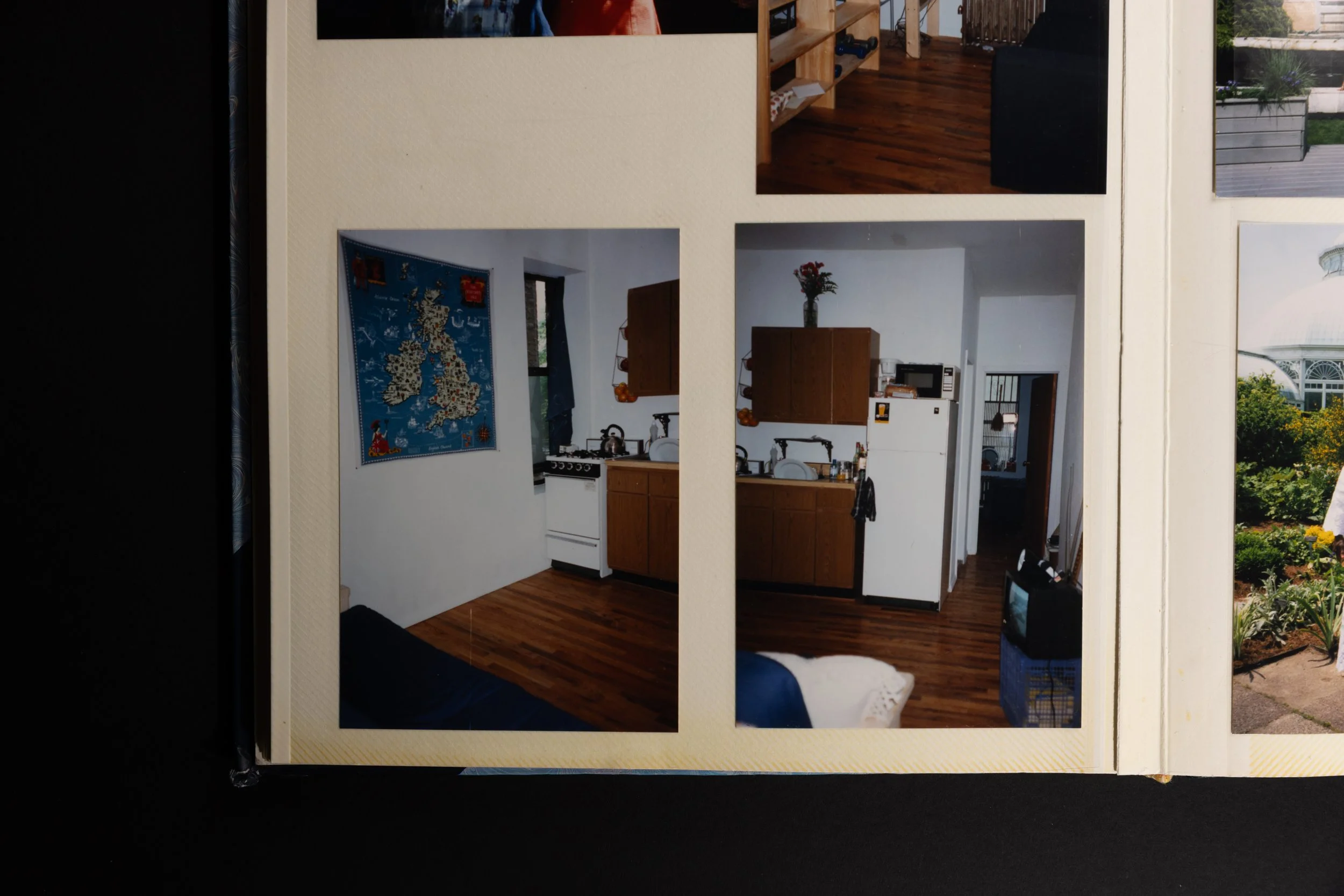
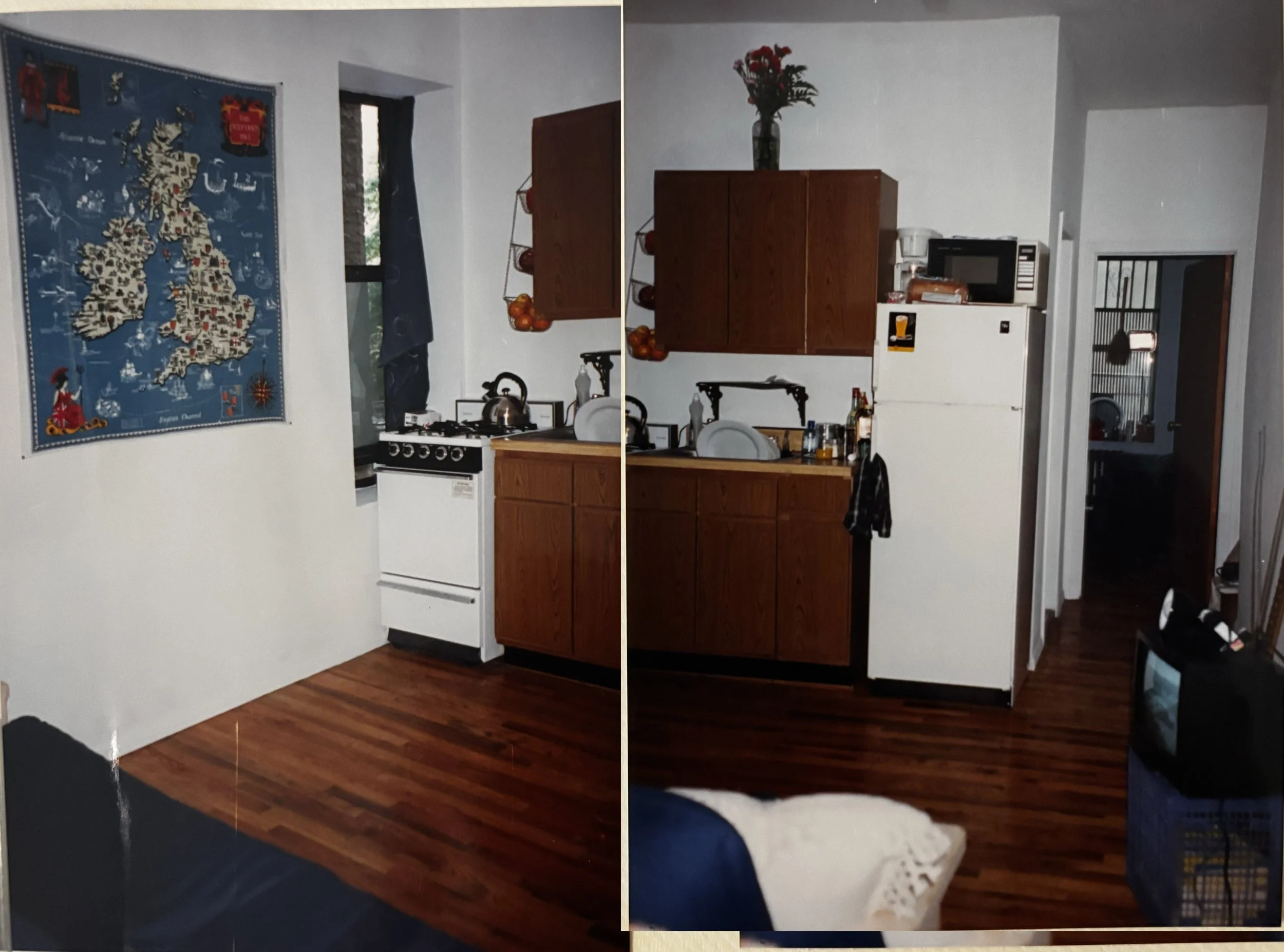
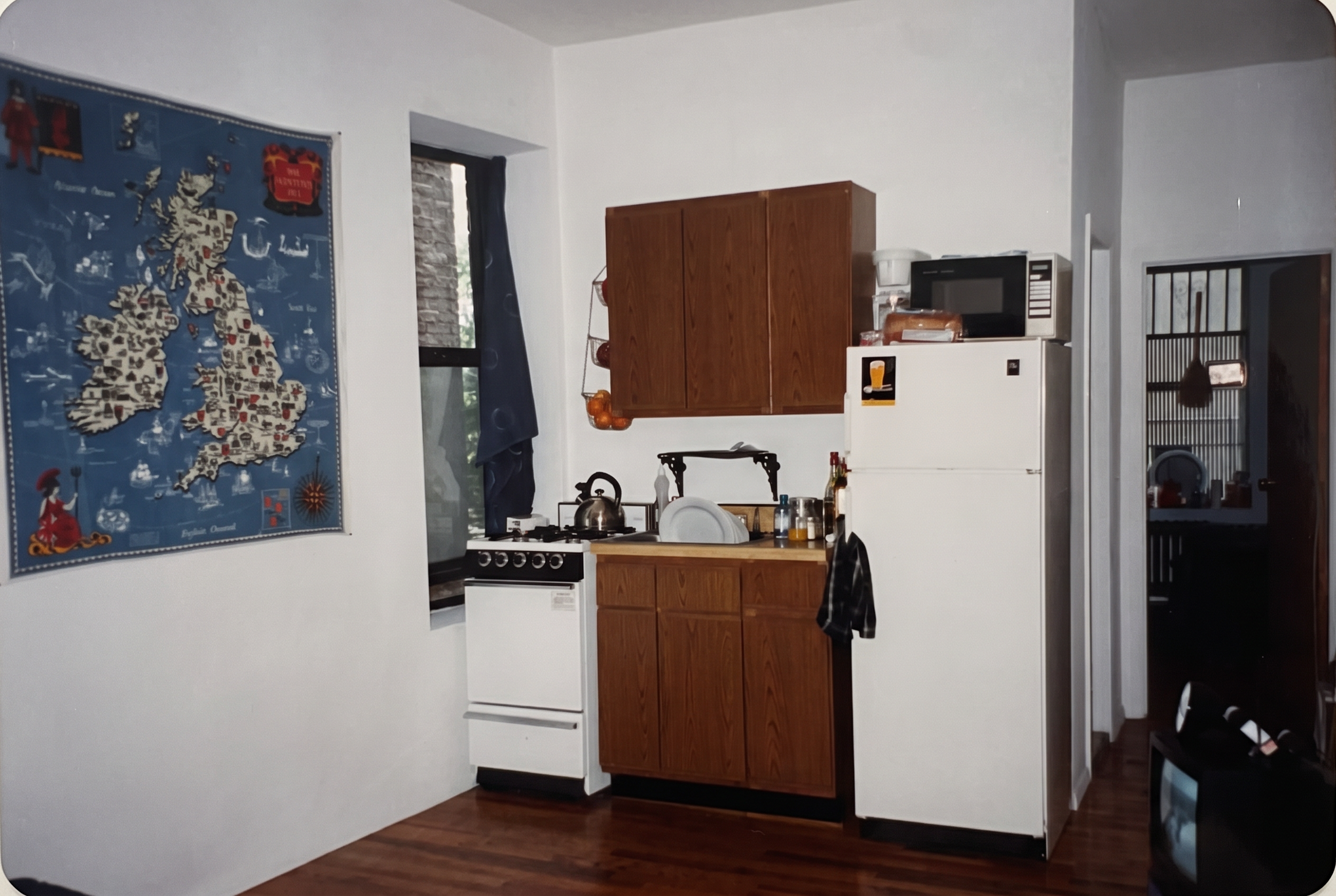
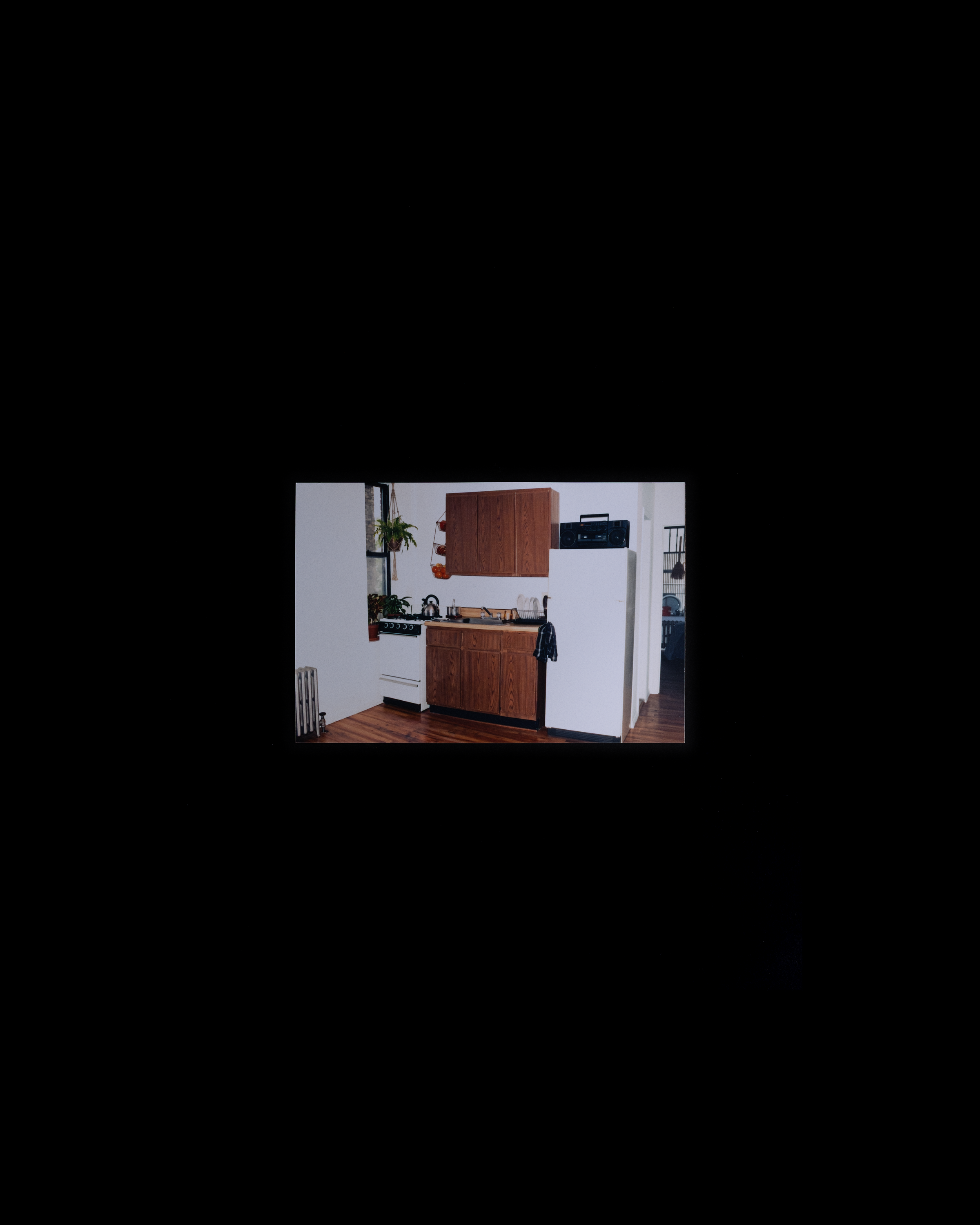
Sophie's kitchen is the clearest example. I built the generated frame from two photographs stuck in an old album of my apartment on Rivington Street: the same room, the same light, most of the same objects. Then I altered it to fit the story rather than my memory. The microwave on my fridge became a boombox, because the manuscript needed somewhere for Sophie to play a cassette. I even got the opportunity to do the dishes 30 years later.
I wasn't asking which image was more authentic. I was asking which one belonged in this archive. My own photograph can be true to my memory and wrong for Sophie's. A generated image can be historically false and still closer to how I imagine her life. Both can be printed, lit, and rephotographed by the same hands. I wanted them to feel as though they came from the same photographer, even if that photographer is fictional.
The Friction of the Real
Not every image on this site came out of a machine. I shot Lila's photographs myself, during a research trip to New York, physically tracing her path through the novel. They exist in the wild, tied to an Instagram account I keep under her name: @lilarae___.
The New Zealand chapters are grounded in reality too. My own family photographed the harbour and the neighbourhood there — places they know first-hand.
But dropping real photographs into a fictional archive creates a strange friction. They're authentic frames of real places, yet the story reframes their history. A photograph being factually real doesn't mean it validates the fiction wrapped around it.
That friction is what interests me about archiving generally. An image never arrives with its meaning attached. Someone kept one print and discarded another. Someone decided which box went into the loft. A family archive doesn't contain the actual past; it holds whatever survived somebody's decisions about what mattered.
The idea for Darla's archive — work found by strangers and published only after its maker died — started with reading about Vivian Maier, though Darla's story runs differently: her family already knew what she'd made, and it was always going to be found.
What Gets Inherited
The characters in the novel inherit photographs, objects, stories, and absences — none of it fully verifiable. That doesn't make it meaningless. It's close to how most people inherit a family past: not as proof, but as objects to hold while imagining what they can't remember. Lila holds a slide of a stranger called Rose. Sophie swaddles her baby in an inherited blanket.
What I'm doing here is more deliberate than that. I built the photographs those characters are inheriting, on purpose, from nothing. The reader knows this, because the key tells them. I'm not claiming that erases the difference between a real inheritance and a fabricated one — it doesn't. I'm interested in something smaller and more honest: what a photograph has to do, materially, to feel like it belongs to someone, even once you know it was made to.
Objects
The objects in this project arrived much like the lost slide did: an old wardrobe key, a Kodak Retina camera, a hand-knit baby blanket from the 1970s. Each was bought on eBay from a stranger's clearance — unclaimed items left behind by anyone who might have wanted them more than I did. Collecting became a quiet practice, folding seamlessly into the fictional archive.
What I Don't Know
I no longer have access to the full Firefly prompt history. What survives are the fragmented filenames the software spat out — the first few words, before cutting off partway through. So what you see here is an account of my practice, not a complete record.
There are deeper questions I can't resolve. Every generated image here came from Google's Gemini model. Adobe's assurances about how its own Firefly models were trained don't apply to it, and Google doesn't give a full account of what its image model learned from. I can't verify any of it. Keeping photographers' names out of my prompts doesn't sidestep that. This is the stage of the project where I have the least control and the least authority to claim. I'd rather admit that blind spot than pretend I can account for an algorithm I can't see.
The Line I Didn't Cross
Some chapters carry no photograph at all. They're set in conflicts far from anything I've lived through, among unnamed people whose suffering has nothing to do with mine. Inventing the visual memory of fictional characters is one thing. Turning real historical trauma into a generated image and asking a reader to look at it is another. I didn't want to make that claim. Those chapters stay blank on purpose — the absence is part of the archive, not a gap in it.
What This Is
I don't call this an archive in the strict sense — there's no family underneath it that existed. What's real is the practice: a copy stand, two lights, a grey card read at the start of every session, the camera locked at the same height, matched paper stock, boxes of objects, photographs made and remade until they held up. The labour is real. The objects are real. The family is not.
I wasn't trying to make photographs that prove a fictional past existed. I was building the conditions under which that past could feel inherited — for a reader who knows, the whole time, exactly what they're looking at.
What Remains
The photograph that started all this is still gone. I never found out who she was, who took the picture, who kept it, or how it ended up in a job lot on eBay. All I could do was build a world around her: a family, a history, photographs, objects, rooms, absences.
The real question was never whether these photographs are real. It's what you do with a person you can't recover.